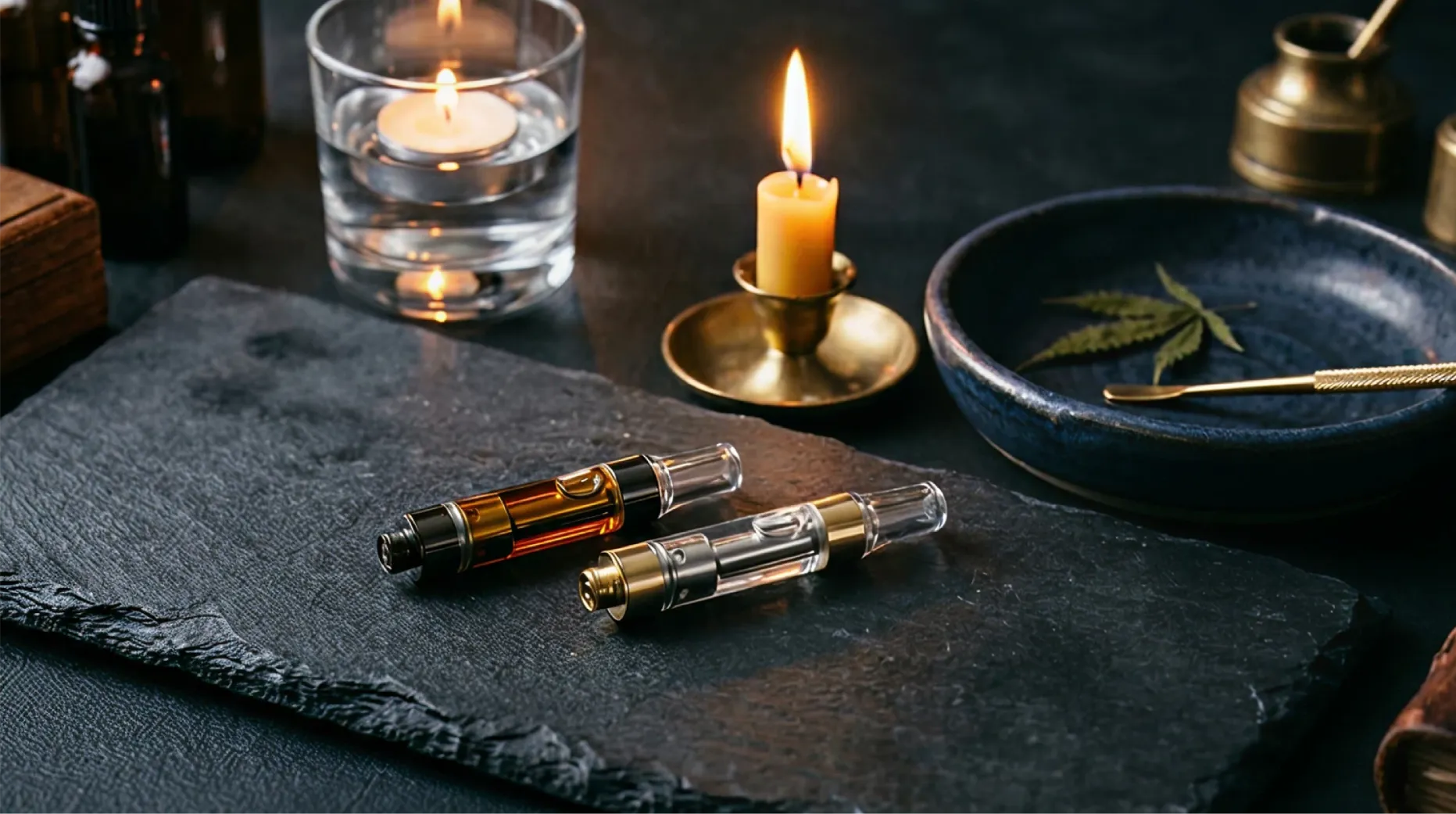
Two cartridges. Similar labels. Nearly identical hardware. The one on the left costs more, and the person behind the counter keeps recommending it, but the product sheet does not explain why in a way that makes sense at the end of a long Thursday. That is the moment most people fall back on THC percentage. It is also the moment most people make the wrong call.
TL;DR
When it comes to live resin vs distillate, the real difference is not about strength. It is about the kind of experience each one is built for, and once you understand that, the choice is simple.
Live resin is made from fresh-frozen cannabis flower, preserving the plant's full terpene and cannabinoid profile. Distillate is a highly refined extract that isolates a single cannabinoid, typically THC, removing nearly all terpenes in the process. Live resin delivers a complex, layered experience shaped by the whole plant. Distillate delivers consistent, direct potency.
What are live resin and distillate carts?
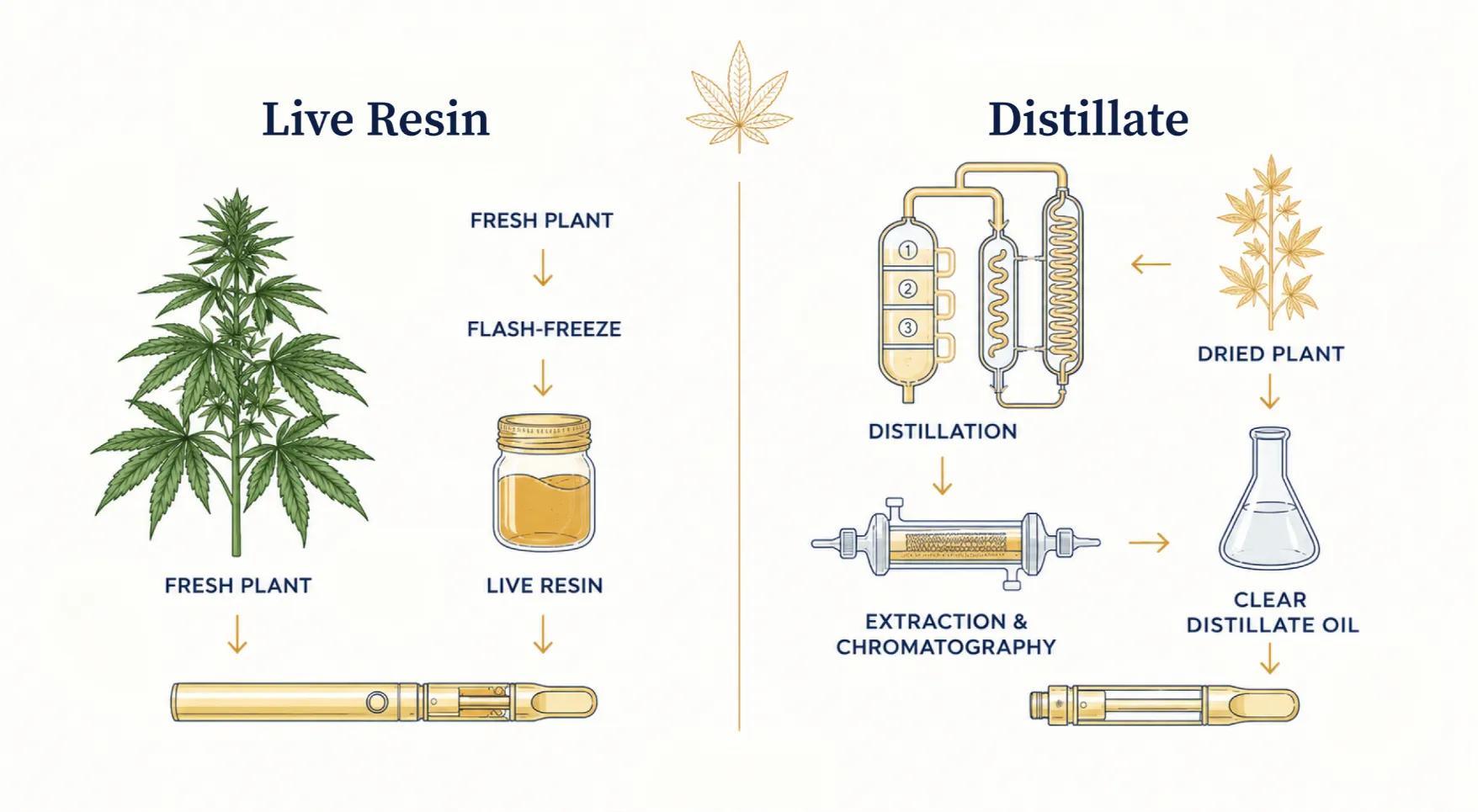
The difference between these two formats starts long before the oil reaches the cartridge.
Live resin begins with freshly harvested cannabis flower that is frozen immediately after cutting, before any drying or curing takes place. That freezing step preserves the terpenes and cannabinoids that would otherwise break down during processing. The result is an extract that carries the plant's full chemical fingerprint, including a terpene content of 3 to 5 percent, according to TribeTokes (2025). Those terpenes are not just responsible for flavor. They shape the direction and quality of the experience.
Distillate follows a different path entirely. The plant material is dried and cured first, then put through a solvent-based extraction followed by a distillation process that strips away nearly everything except the target cannabinoid. A finished distillate typically contains 85 to 99 percent pure THC, according to Leafwell (2025). Most of the terpenes, minor cannabinoids, and other plant compounds are removed during that process. Some manufacturers add terpenes back in afterward, but these are often botanical or synthetic, and they produce a flatter aroma than what naturally survives in live resin (Leafwell, 2025).
Neither extraction method is better in every situation. They are designed for different outcomes.
How do live resin and distillate carts compare?
The clearest way to understand the live resin vs distillate cart difference is to look at what each one actually delivers across the attributes that matter for an evening experience.
| Attribute | Live Resin Cart | Distillate Cart |
|---|---|---|
| Source material | Fresh-frozen whole flower | Dried, cured flower or trim |
| Terpene content | 3–5% (natural, strain-specific) | 0–1% (often reintroduced) |
| THC concentration | 60–95% | 85–99% |
| Effect profile | Complex, balanced, entourage-driven | Direct, potent, one-dimensional |
| Flavor and aroma | Rich, strain-true, layered | Near-odorless or added terpene blend |
| Best use for evening | Sensory, ceremonial wind-down | Consistent, predictable dose control |
| Price range (NY, 2026) | $50–$100+ per cart | $30–$60 per cart |
| Ideal vape voltage | 2.2–3.0V | 2.8–3.6V |
Sources: TribeTokes (2025), Leafwell (2025), The Kind Pen (2026), Headset NY (April 2026)
The most important number in that table is not the THC column. It is the terpene content column. A distillate at 95 percent THC and a live resin at 75 percent THC will not produce identical experiences, because the terpene profile in the live resin shapes how that THC lands.
Why does the live resin vs distillate difference matter for your evening?
The concept behind this is called the entourage effect. A 2024 review published in the journal Pharmaceuticals described it as a major framework for understanding cannabis-based medicine, pointing to terpenes like beta-caryophyllene, limonene, and pinene as significant modulators of cannabinoid activity (Russo & Marcu, 2024 via Pharmaceuticals). In plain terms: the terpenes and cannabinoids in a full-spectrum product work together, and the combined experience is different from THC working alone.
For a live resin cart, that translates directly into the evening.
What terpenes in live resin are associated with relaxation?
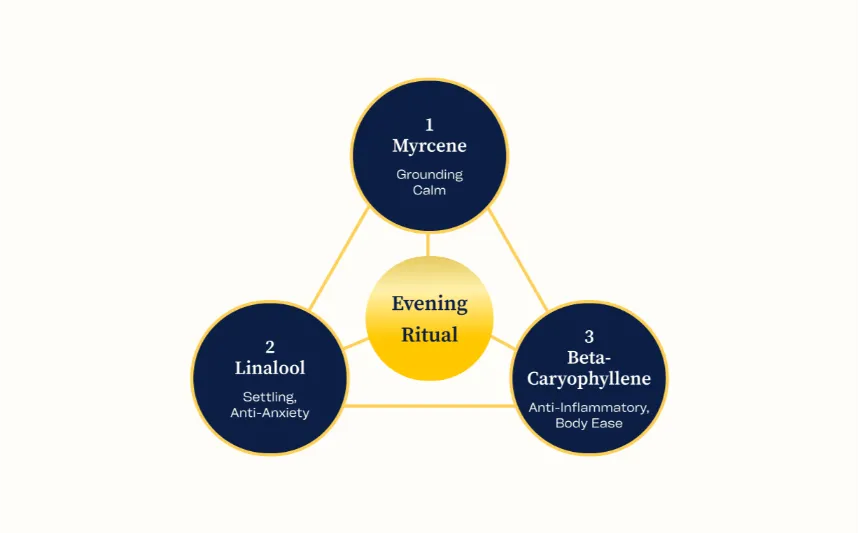
Three terpenes appear consistently in the research on cannabis and calm.
Myrcene is one of the most common terpenes in cannabis and is associated with a settling, grounding effect. Exploratory research suggests it may contribute to the heavier, body-focused quality found in many indica-leaning strains (Weed.com, 2025). The evidence is preliminary, but the pattern is consistent enough that experienced users and many budtenders treat myrcene content as a reliable signal for evening products.
Linalool is linked in early research to calming and anti-anxiety properties. It is also found in lavender and has been associated in some studies with GABA pathway activity, the same system that many pharmaceutical sleep aids target (NCBI PMC, 2025). Again, these findings are exploratory. No clinical trials have confirmed linalool's effects in humans at cannabis-relevant doses. What the research does suggest is a directional relationship between linalool presence and a smoother, more settled experience.
Beta-caryophyllene is unique among terpenes because it binds directly to CB2 receptors in the body's endocannabinoid system. It is associated with anti-inflammatory and grounding properties and appears in a number of evening-oriented strains (Pharmaceuticals, 2024).
Distillate, with its terpene content below one percent, does not deliver this kind of shaped experience. It delivers THC. For some evenings, that is exactly what is needed. For a ritual built around intentional calm, live resin gives you more to work with.
When should you choose live resin over distillate?
This is the question that matters most at the shelf, and the answer depends entirely on what the evening calls for.
Choose live resin when the ritual is the point. If the night is intentional, the pace is slow, and you want the full sensory experience of the plant, live resin belongs there. The layered terpene profile means the experience has texture to it. You will taste something. You will feel something that shifts gradually rather than arriving all at once. For a designed calm, that process is part of the value.
Choose distillate when consistency matters more than complexity. Long week. Tired. No interest in nuance. Just reliable delivery at a dose you already understand. Distillate is built for exactly that kind of evening. Its stripped-down formulation means fewer variables, which makes it easier to predict how you will feel 20 minutes from now. For daily use, that predictability has real value.
One other factor worth naming: distillate produces significantly less aroma than live resin. In a New York apartment with thin walls and close neighbors, that is a practical consideration that some people factor into the decision.
Neither format is universally better. They serve different intentions on different nights. A well-stocked dispensary carries both, and the budtender conversation at JD's Jungle is specifically designed to help you identify which one fits the evening you are trying to build. Certificates of Analysis (COAs) showing terpene breakdown by product are available on request in-store.
What does the price difference between live resin and distillate actually mean?
In New York's legal cannabis market, the average item price across all categories sat at $29.22 in April 2026, according to Headset market data. Live resin carts typically run 20 to 40 percent higher than comparable distillate products, according to The Kind Pen (2026). That premium reflects the cost of the process: specialized flash-freezing equipment, a smaller yield per batch, and the labor involved in handling fresh material on a tight timeline from harvest to extraction.
For daily use, distillate offers strong value. The consistency is reliable, the cost per session is lower, and the results are predictable. For a specific ritual night, the live resin premium is an investment in a fuller experience. A single-origin coffee costs more than a standard blend. The difference is not always the caffeine content. It is what the experience actually feels like.
Both formats are available at licensed New York dispensaries including JD's Jungle, with COA documentation available on request. The right question is not which one is worth more. It is which one is worth more tonight.
The cart you choose is part of the ritual
Two cartridges. Now you know what separates them.
Live resin carries the plant's full character. It delivers a shaped, sensory experience for the nights when the ritual itself is the point. Distillate delivers clean, consistent potency for the nights when simplicity is the better choice. Neither is universally superior. They serve different intentions, and a well-designed evening ritual uses both at the right times.
The decision gets easier once you know your terpene preferences, your usual dose, and the kind of evening you are building. Your budtender at JD's Jungle can walk you through both.
Please note
This content is for educational purposes only and does not constitute medical advice. Cannabis affects individuals differently. Must be 21+ to purchase in New York State.
FAQs
Not necessarily. Distillate typically contains 85 to 99 percent THC, which is often higher than the 60 to 95 percent found in live resin (The Kind Pen, 2026). But potency and quality of experience are two different things. Distillate delivers more THC per pull. Live resin delivers a more complete plant-derived experience, shaped by its terpene profile. Which one feels stronger depends on the person and the dose, not just the percentage on the label.
Yes, significantly. Live resin retains the plant's natural terpenes at 3 to 5 percent, producing a flavor that reflects the specific strain it came from (TribeTokes, 2025). That might be earthy, floral, citrus, or herbal depending on the genetics. Distillate has virtually no natural terpenes remaining after processing. Where terpenes are added back in, they are typically botanical or synthetic and produce a noticeably flatter, less layered aroma than what live resin carries naturally (Leafwell, 2025).
Lower temperatures preserve the terpene profile and deliver a smoother, more flavorful pull. A voltage between 2.2V and 3.0V is the recommended range for live resin carts. Higher settings burn off terpenes faster and can produce a harsh or muted draw. Distillate carts generally perform well between 2.8V and 3.6V (The Kind Pen, 2026). If your device has adjustable voltage, start at the lower end with live resin and increase gradually until the draw feels right.
For a deliberate evening ritual where the texture of the experience matters, live resin delivers a depth that distillate cannot match at any price. For functional daily use where consistency and cost are the priority, distillate is the more sensible choice. Both formats are available at licensed New York dispensaries, with lab documentation confirming the terpene and cannabinoid profile of each product. The right question is not whether live resin is worth the premium in general. It is whether it is worth the premium for the specific evening you are planning.
Yes. Distillate's predictability is a feature for certain ritual designs, especially when a consistent, measurable dose matters more than a layered sensory experience. The trade-off is that without a natural terpene profile, the experience is driven almost entirely by THC. That makes the effect less shaped and more dependent on dose management. For many people on many nights, that directness is exactly what the ritual calls for. It depends on the kind of calm you are trying to design.
Visit JD's Jungle
Explore our selection of live resin and distillate carts at JD's Jungle in New York. Our team will walk you through terpene profiles, COA documentation, and the format that fits the evening you are designing. No guesswork. Just premium quality, transparent details, and the right product for your ritual. Browse our lookbook or come in.
Find a locationReferences
- Headset. (2026, April). New York cannabis market pricing data. https://www.headset.io/markets/new-york
- Leafwell. (2025). Live resin vs distillate: What is the difference. https://leafwell.com/blog/live-resin-vs-distillate
- Russo, E. B., & Marcu, J. (2024). Cannabis pharmacology. Pharmaceuticals. https://www.ncbi.nlm.nih.gov/pmc/articles/PMC11870048/
- The Kind Pen. (2026). Distillate vs live resin cart: Which is right for you. https://www.thekindpen.com/blog/distillate-vs-live-resin-cart/
- TribeTokes. (2025). Live resin vs distillate: A complete guide. https://tribetokes.com/learn/cannabis-education/live-resin/live-resin-vs-distillate/