Most people pick cannabis based on THC percentage. Most people are also disappointed more often than they need to be. The number printed largest on a cannabis label tells you one thing: potency. It says nothing about whether you will feel alert or sedated, anxious or calm, focused or flat. Two products with identical THC content can produce completely different experiences. The variable that accounts for most of that difference is the terpene profile, and three terpenes show up across New York dispensary shelves more than any others: limonene, myrcene, and linalool. Knowing what each one does changes how you shop.
TL;DR
Most people shop by THC percentage. Three terpenes — limonene, myrcene, and linalool — predict your experience far better. Knowing what each one does changes how you shop.
Terpenes are aromatic compounds found in cannabis and hundreds of other plants. They influence how cannabis affects you by interacting with cannabinoids like THC and CBD. Limonene, myrcene, and linalool are among the most common. Each one is associated with distinct effects, from daytime focus to evening rest to anxiety relief.
Why terpene effects determine your experience more than THC
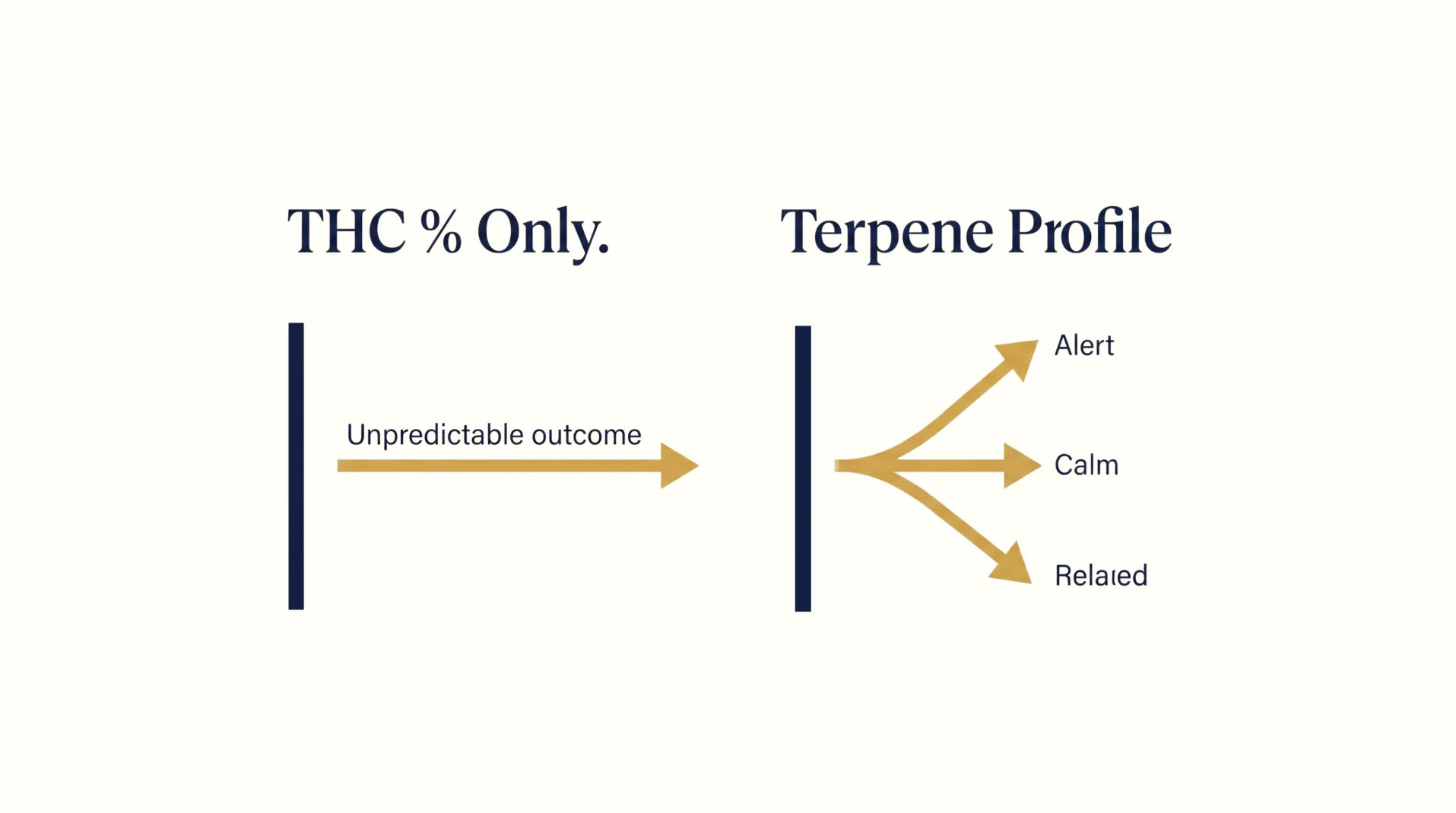
THC tells you how strong a product is. Terpenes help shape the direction that strength takes.
This interaction is known as the entourage effect: cannabinoids and terpenes working together produce outcomes that neither creates alone. The clearest human evidence for this comes from a 2024 controlled study led by Tory Spindle, Ph.D., at Johns Hopkins University. Researchers found that when D-limonene was inhaled alongside THC, it significantly reduced THC-induced anxiety in a dose-dependent pattern, without blocking any of the other effects of THC (Spindle et al., Drug and Alcohol Dependence, 2024). The terpene changed the shape of the experience without diminishing it.
New York cannabis shoppers are already moving in this direction. A 2026 market analysis by MG Magazine, drawing on Nielsen IQ data, found that four in ten consumers now look beyond THC percentage and actively seek products with full cannabinoid and terpene profiles. That shift is happening because people have started reading their Certificates of Analysis and because dispensaries with knowledgeable staff are teaching them what to look for.
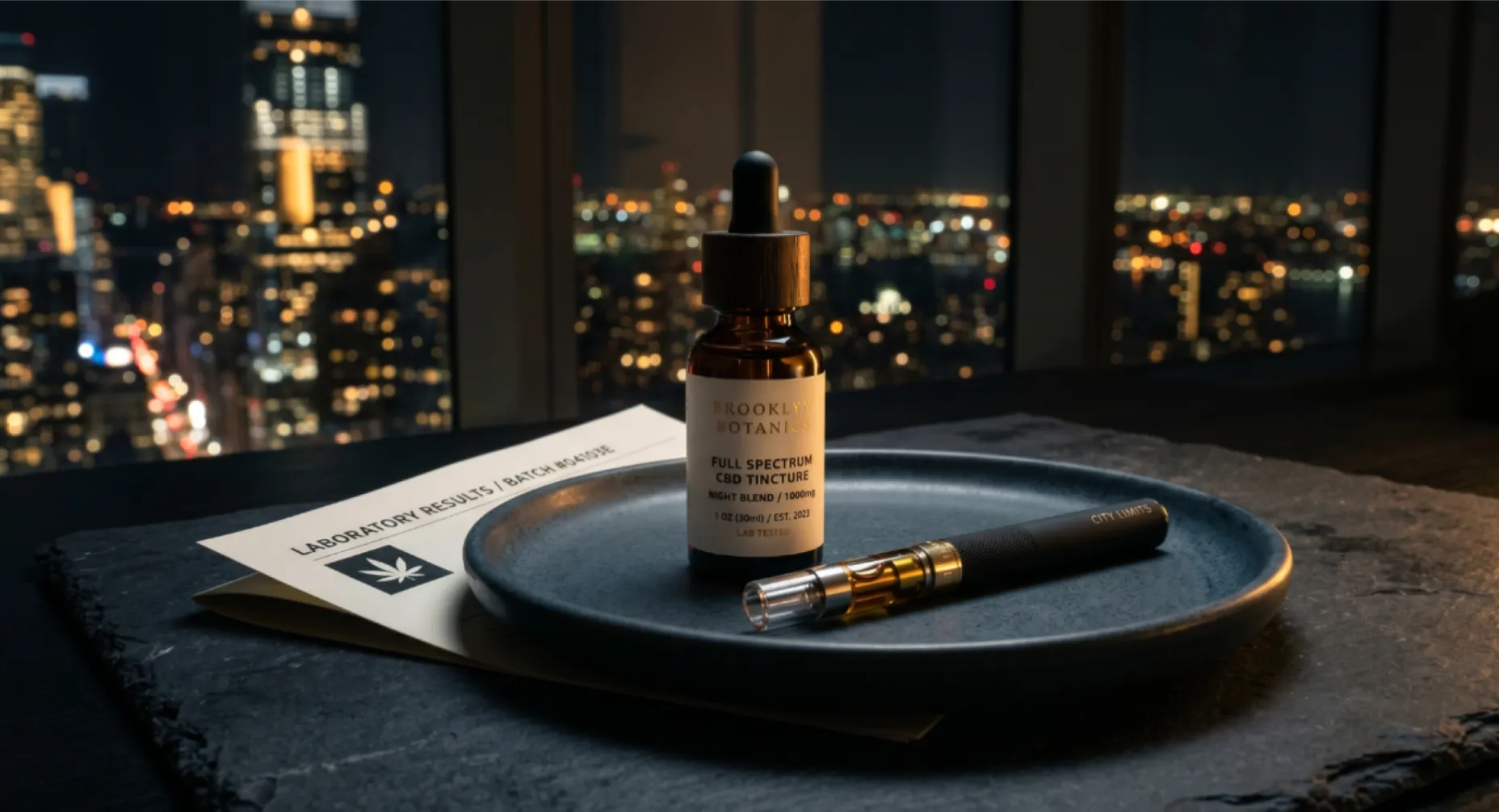
Every licensed cannabis product sold in New York has a COA. The terpene section of that document, reported as a percentage by weight, is where the real selection information lives.
What limonene terpene effects feel like in practice
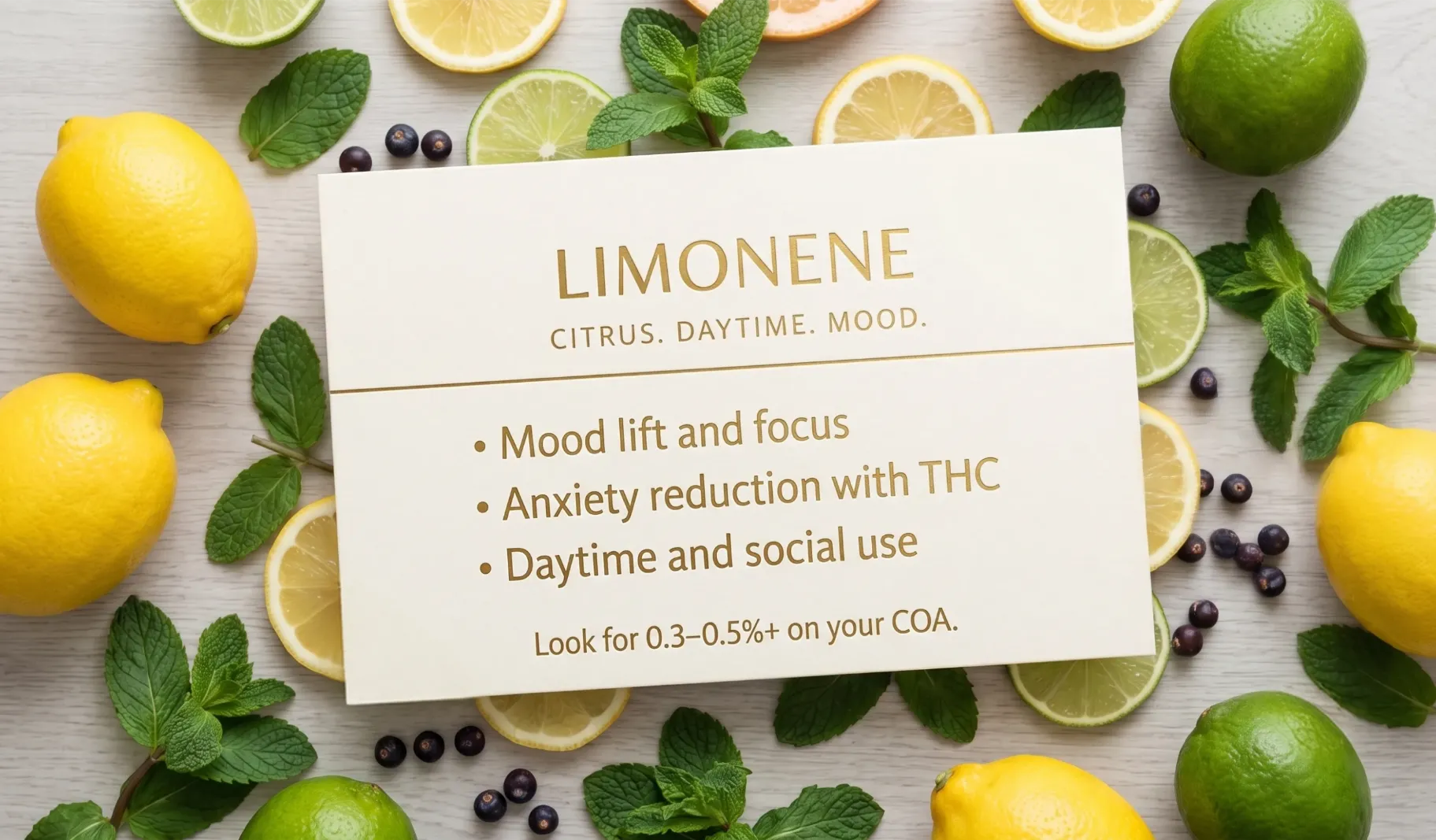
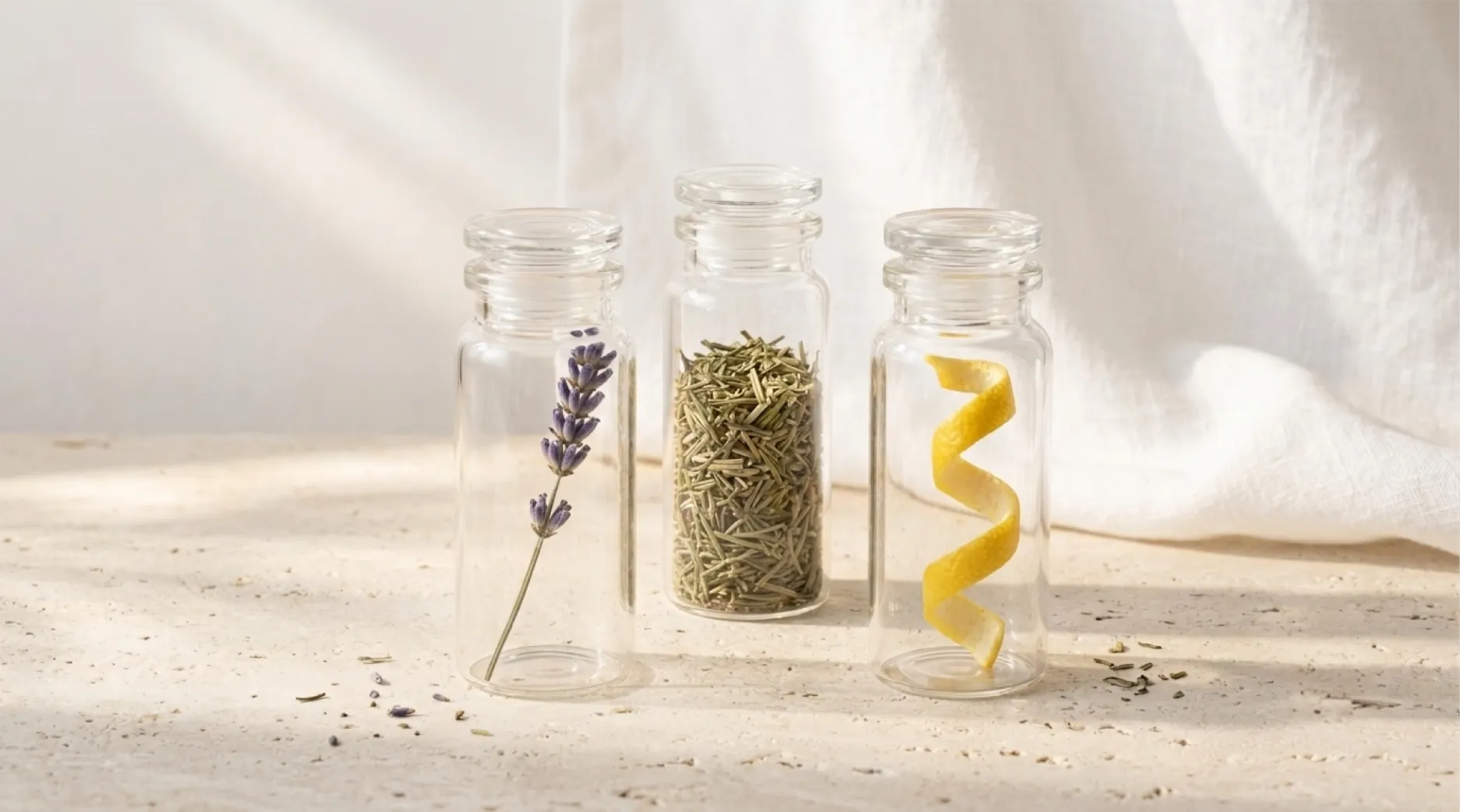
Limonene is the compound responsible for the sharp, clean smell of lemon peel and orange rind. You find it in citrus fruits, juniper berries, and peppermint, and it appears frequently in sativa-leaning cannabis varieties. When you pick up a product and the first thing you notice is a bright, almost electric citrus note, you are very likely detecting limonene.
What the research says about limonene terpene effects
The most credible human evidence on limonene comes from the 2024 Johns Hopkins study. Researchers at Johns Hopkins University and the University of Colorado ran a double-blind, placebo-controlled crossover trial with 38 participants. The group that inhaled D-limonene alongside a 30mg dose of THC reported significantly reduced anxiety, nervousness, and paranoia compared to the THC-only group. The reduction was dose-dependent: more limonene produced more pronounced effects (Spindle et al., 2024; Drexel University Cannabis Research, 2024).
A separate study published in the European Journal of Neuroscience in June 2024 found that D-limonene reduced anhedonia (the inability to feel pleasure) and improved memory and learning by offsetting stress-related neuroinflammation. The proposed mechanism involves adenosine A2A receptor regulation of dopaminergic and GABAergic activity (MMJ.com, 2025).
One honest note: this is still early-stage human research. The Johns Hopkins study is the first controlled human trial specifically examining limonene's interaction with THC. It is significant, but it is one study. The picture will become clearer as more trials are completed.
When to reach for a limonene-forward product
Limonene is the terpene for mornings, creative sessions, and social situations where you want to stay present and engaged. Users consistently describe limonene-forward products as uplifting, talkative, and mentally clear.
On a COA, look for limonene listed above 0.3-0.5% in the terpene section. Sativa-dominant flower and daytime vape cartridges are the formats most likely to carry it at meaningful concentrations. At JD's Jungle, ask the team to show you the COA on a daytime option and point to the limonene reading.
What myrcene terpene effects feel like in practice
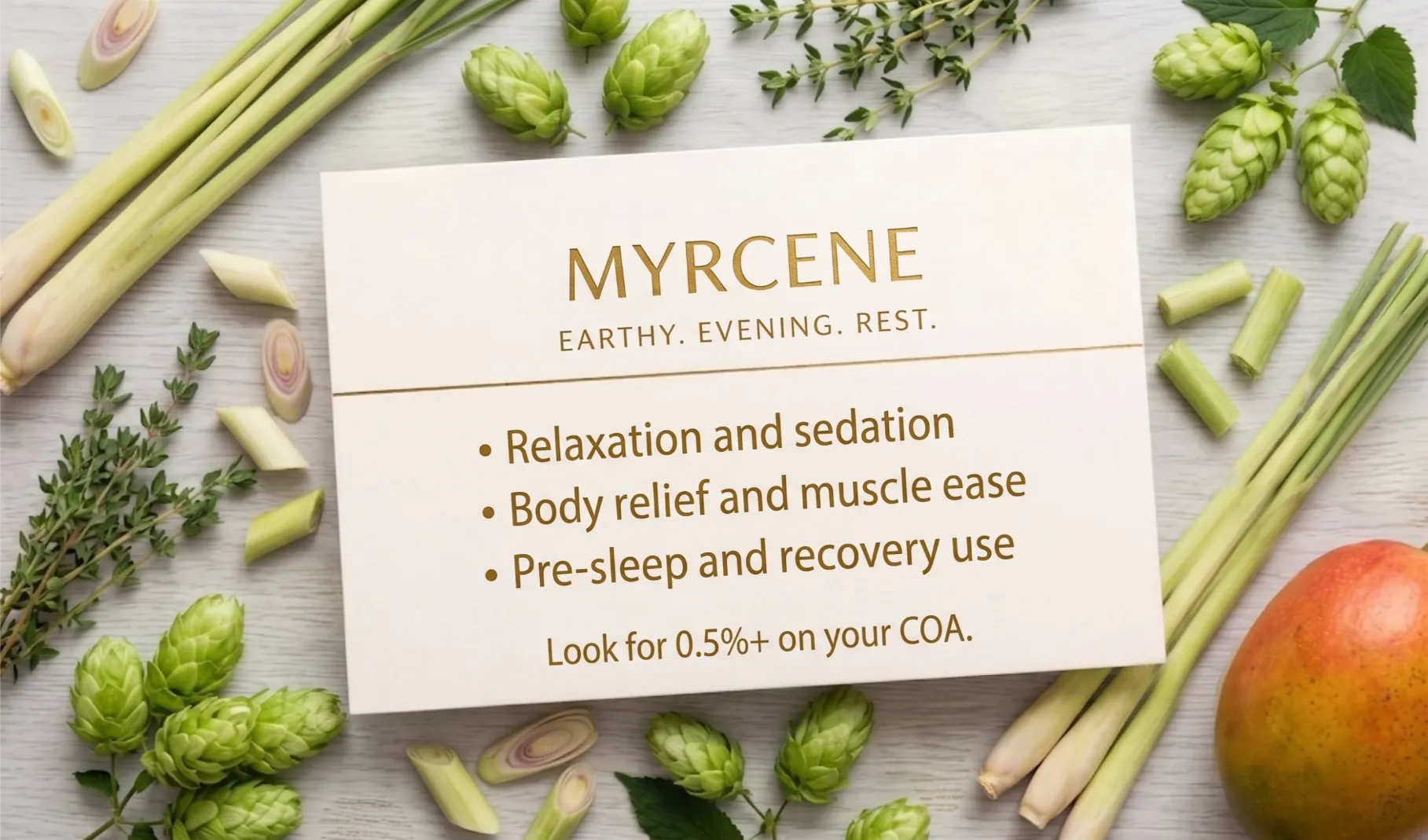
Myrcene is responsible for the deep, earthy, slightly musky smell that most people associate with classic indica cannabis. You find it in mango, hops, lemongrass, and thyme. In cannabis specifically, myrcene is the single terpene most strongly correlated with indica labeling: a study published in Nature Plants found that myrcene concentration alone explained 21.2% of the variation in indica versus sativa classification across more than 100 tested samples (Nature Plants, 2021). No other terpene came close to that correlation.
What the research says about myrcene terpene effects
Myrcene appears to work by enhancing activity at the GABA-A receptor, the same inhibitory receptor targeted by benzodiazepine medications. In animal studies, it slowed motor activity, increased sleep time, and produced muscle relaxation. Research published in the British Journal of Pharmacology (Russo, 2011) found that when beta-myrcene is combined with THC, it may intensify THC's sedative properties, contributing to what cannabis users have long described as "couch-lock."
A note on the evidence: the sedative data on myrcene is consistent and well-supported in animal models, and it aligns closely with decades of consumer self-report. However, controlled human trials specifically testing myrcene's sedative effects are still ongoing. The University of California, Los Angeles is currently running a placebo-controlled study examining myrcene's analgesic and subjective effects in humans (ClinicalTrials.gov, NCT04451863). The honest position is that the animal science is strong and the consumer experience is consistent, but the human trial data is not yet complete.
When to reach for a myrcene-forward product
Myrcene is the evening terpene. Post-work decompression, physical recovery after training, pre-sleep wind-down. If you want to feel settled rather than stimulated, this is where to look.
On a COA, myrcene above 0.5% is a reliable indicator of an indica-leaning, body-oriented experience. It is the most commonly dominant terpene in evening flower products. If sleep is the specific goal, pairing a myrcene-forward product with a THC+CBN formulation compounds the settling effect. Ask for both at the counter and let the team show you the terpene breakdown on each option.
What linalool terpene effects feel like in practice
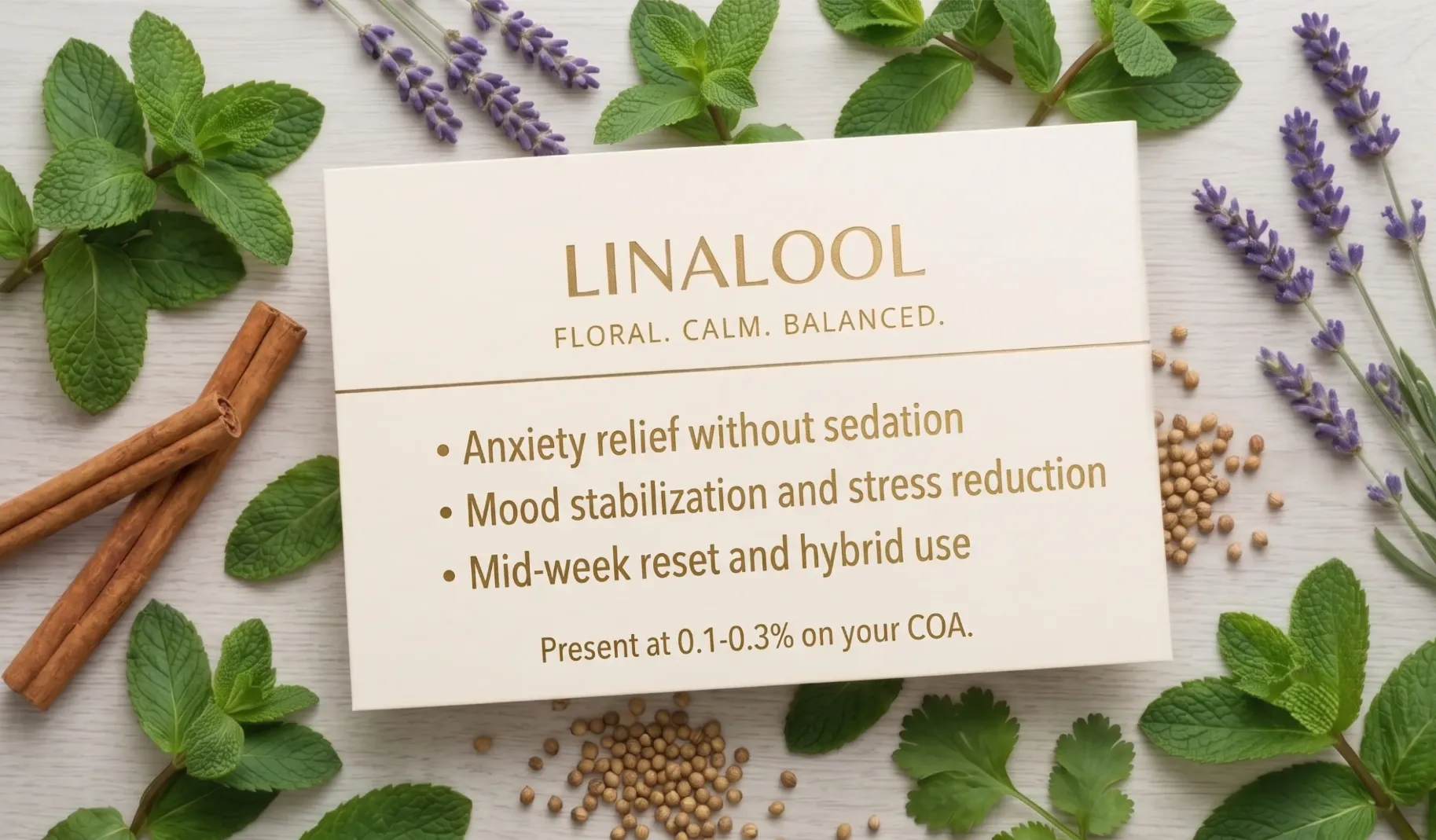
Linalool is the softest of the three. Floral, lavender-forward, with a faint spice underneath. It appears in over 200 plant species including lavender, mint, cinnamon, and coriander, and it is already well-known in aromatherapy for its calming properties. In cannabis, linalool rarely appears as the dominant terpene. It tends to show up as a supporting note in balanced hybrid profiles, contributing a settling quality without pushing the experience toward full sedation.
What the research says about linalool terpene effects
A 2021 review published in Frontiers in Psychiatry examined the evidence for linalool across neurological and psychiatric applications. The review identified linalool as a candidate for further investigation in insomnia, anxiety, and depression, noting that it influences multiple neurotransmitter pathways and demonstrates psychoactivity, despite being non-intoxicating (Kamal et al., Frontiers in Psychiatry, 2021).
One finding stands out. Research suggests that linalool may affect the brain partly through its aroma, via olfactory pathways, rather than solely through systemic absorption into the bloodstream. This would mean that even at lower concentrations, linalool-forward products could produce a calming signal. A related finding: unlike benzodiazepines, which produce similar anti-anxiety effects, linalool appears to work without impairing motor function (Higher Leaf, 2024).
The same honest caveat applies here as it does with myrcene: well-designed human clinical trials are still limited. The Frontiers in Psychiatry review was explicit about this gap. What exists is consistent preclinical evidence and a strong mechanistic hypothesis.
When to reach for a linalool-forward product
Linalool is the terpene for the high-stress day you want to decompress without going flat. Social anxiety management. The mid-week reset that needs to be calming without being sedating. If myrcene is the terpene that switches you off, linalool is the one that turns the volume down.
On a COA, linalool typically appears between 0.1-0.3%. Even at those concentrations, it contributes meaningfully to the overall profile of a balanced hybrid. Tell the team you want something calming but not heavy, and ask them to pull the COA. If linalool is present alongside low myrcene, that combination tends to produce exactly that experience.
Limonene vs myrcene vs linalool: terpene effects at a glance
Before your next dispensary visit, this is the only table you need.
| Terpene | Aroma | Primary effects | Best occasion | COA signal |
|---|---|---|---|---|
| Limonene | Citrus, lemon peel | Mood lift, focus, anxiety reduction | Daytime, social, creative work | Look for 0.3–0.5%+ |
| Myrcene | Earthy, musky | Relaxation, sedation, body relief | Evening, recovery, pre-sleep | Look for 0.5%+ |
| Linalool | Floral, lavender | Anxiety relief, calm, mood balance | Stress reset, mid-week, gentle evenings | Present at any level |
Ask to see the COA on any product at the counter. The terpene section will show exactly what you are working with before you decide.
How to read a COA for limonene, myrcene, and linalool terpene effects
Every cannabis product sold at a licensed New York dispensary must pass laboratory testing before it reaches the shelf. That test produces a Certificate of Analysis, or COA. Under New York OCM regulations (updated 2025-2026), terpene content must be disclosed on the COA and reported as a percentage by weight (NY OCM Part 128 Guidance; NY OCM Testing Limits, 2025). Many dispensaries now include a QR code on the product label that links directly to the digital COA.
To use the COA for terpene selection, look past the cannabinoid section at the top. Scroll to the terpene profile section. You will see a list of terpene names with a percentage next to each one. Limonene, myrcene, and linalool will typically appear there if they are present at measurable concentrations. The highest percentage on that list is usually the terpene shaping most of the experience.
This is the difference between guessing and knowing. A product labeled "hybrid" tells you almost nothing. A COA showing myrcene at 0.8% and linalool at 0.2% tells you exactly what kind of evening you are buying.
Closing
Limonene, myrcene, and linalool will not tell you everything about a cannabis product. But they will tell you more than the THC percentage will.
Understanding what each terpene is associated with turns the dispensary visit from a guessing exercise into a selection process. You walk in knowing what kind of experience you want. You read the COA. You ask one question about the terpene profile. Then you walk out with something that actually fits the occasion.
That is what shopping with intention looks like.
Please note
This content is for educational purposes only and does not constitute medical advice. Cannabis affects individuals differently. Must be 21 or older to purchase cannabis products in New York State. If you have questions about cannabis and your health, consult a licensed healthcare provider.
FAQs
Yes, with context. Terpenes influence the cannabis experience by interacting with cannabinoids through what researchers call the entourage effect. The 2024 Johns Hopkins study on D-limonene and THC is the strongest controlled human evidence to date. Most other terpene research remains preclinical, but the results across animal studies and consumer experience are consistent.
Limonene-forward products are typically described as uplifting, clear-headed, and social. The 2024 Johns Hopkins study found that limonene specifically reduced THC-induced anxiety without blocking any of THC's other effects. For daytime or social use, a product with limonene above 0.5% on the COA is a reasonable starting point.
Products with high myrcene tend to feel settling, heavy, and physically relaxing. The characteristic indica experience most people recognize, earthy smell and body-forward relaxation, is largely driven by myrcene. Animal research published in the British Journal of Pharmacology (Russo, 2011) found that myrcene combined with THC intensifies sedation. Human trials are ongoing, but the consumer experience aligns closely with the animal data.
Linalool is calm without weight. It is associated with anxiety reduction and mood balance, and it appears to work partly through the olfactory system rather than solely through blood absorption. The Frontiers in Psychiatry review (Kamal et al., 2021) identified linalool as a candidate for anxiety and insomnia applications, though clinical human trials are still limited.
On the Certificate of Analysis for any licensed NY product. Ask at the counter and the team can pull it up, or scan the QR code on the product packaging. The terpene section shows each terpene present and its percentage by weight. New York OCM regulations require terpene content to be disclosed on the COA if the product's terpene content is marketed (NY OCM Part 128 Guidance).
Visit JD's Jungle
Come into JD's Jungle and tell the team what you are looking for. We will pull the COA on any product and walk you through the terpene profile before you decide. No guesswork. Just the right fit for your evening, your morning, or wherever you are headed next.
Find a locationReferences
- Spindle, T. R., et al. (2024). Vaporized D-limonene mitigates the anxiogenic effects of THC. Drug and Alcohol Dependence. https://www.hopkinsmedicine.org/news/newsroom/news-releases/2024/04/researchers-show-chemical-found-naturally-in-cannabis-may-reduce-anxiety-inducing-effects-of-thc
- Russo, E. B. (2011). Taming THC: Phytocannabinoid-terpenoid entourage effects. British Journal of Pharmacology. https://www.ncbi.nlm.nih.gov/pmc/articles/PMC3165946/
- Vigil, J. M., et al. (2021). Cannabis labelling and terpene synthase genes. Nature Plants. https://www.nature.com/articles/s41477-021-01003-y
- Kamal, B. S. K., et al. (2021). Pinene and linalool as terpene-based medicines for brain health. Frontiers in Psychiatry. https://www.frontiersin.org/journals/psychiatry/articles/10.3389/fpsyt.2021.583211/full
- Office of Cannabis Management, New York State. (2025). Part 128: Packaging and labeling guidance. https://cannabis.ny.gov/part-128-guidance