Most people make this decision by accident. They grab a gummy because it looks familiar, or a tincture because someone at the dispensary suggested it, and then they're surprised when the experience doesn't land the way they expected. The format you choose determines when the effects arrive, how strong they feel, and how long they stay. Getting that right is not complicated. It just requires knowing what you're choosing between.
TL;DR
Tinctures and edibles work differently. Which one fits depends on your timing, your tolerance, and your goal — the format should follow your intent, not the other way around.
A tincture is a liquid cannabis extract taken under the tongue. It absorbs into the bloodstream in 15 to 45 minutes and typically lasts 2 to 4 hours. An edible is a cannabis-infused food product that passes through the digestive system, taking 45 to 90 minutes to take effect but lasting considerably longer, often 4 to 8 hours. The format you choose should match the outcome you want.
How do tinctures and edibles actually work differently in the body?
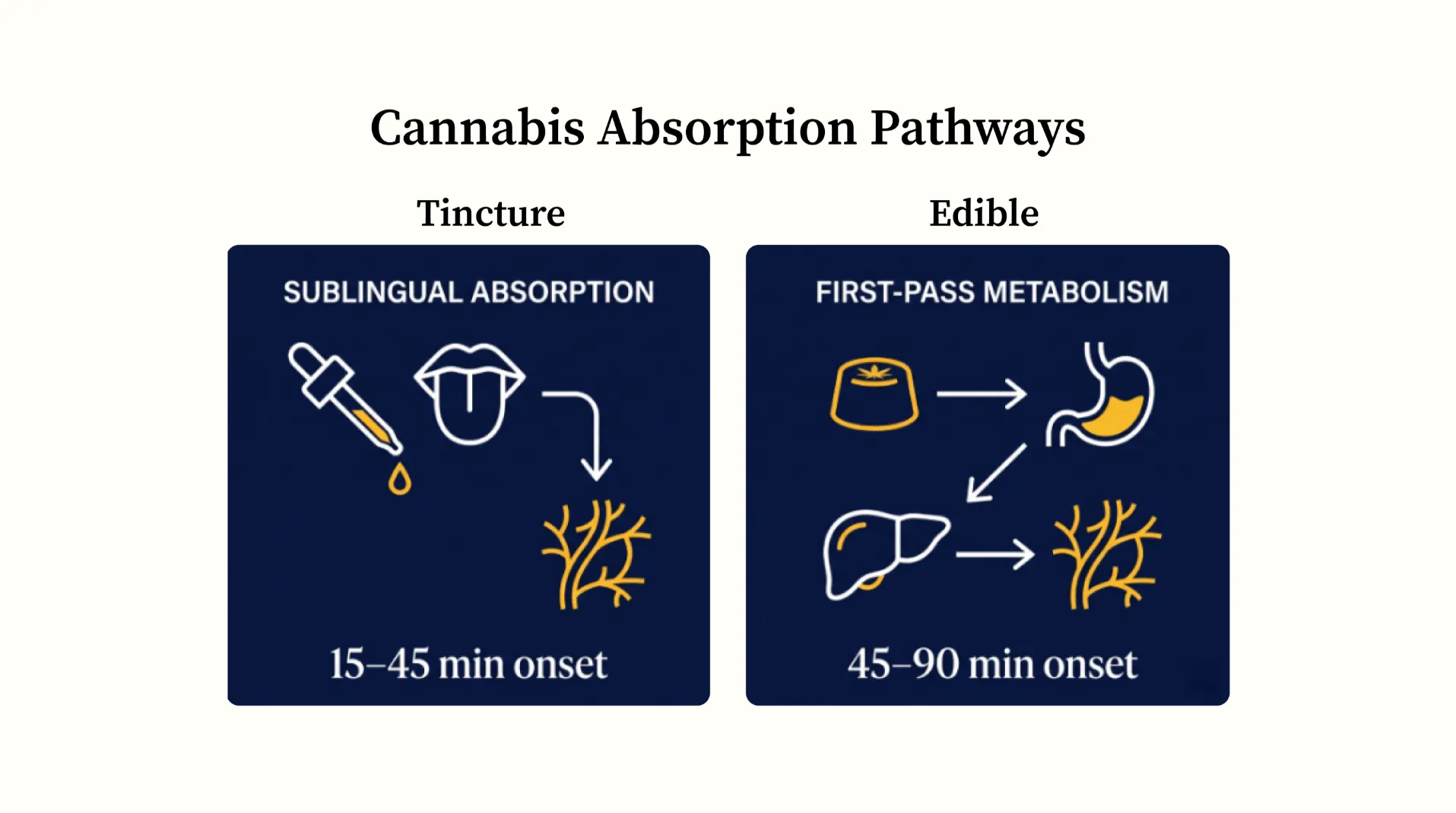
When you place tincture drops under your tongue, the tissue there is thin and well supplied with blood vessels. The active compounds absorb directly into the bloodstream within minutes, skipping most of the digestive process. Effects arrive relatively quickly and feel clear and manageable for most users. The experience is shorter because the compounds don't go through the liver's full processing cycle.
Edibles work on a completely different schedule. After you swallow a gummy, it travels through your stomach and into your intestines before the cannabinoids enter your bloodstream. Along the way, the liver converts THC into a compound called 11-hydroxy-THC. This metabolite is more potent and stays in the body longer than THC absorbed sublingually. That's why edibles feel stronger to many people, and why the effects can last well into the next several hours.
The most common mistake with edibles is not waiting long enough. Someone takes a gummy, feels nothing after 45 minutes, takes another, and then both arrive at once. Understanding the timing of each format is the first step to having a consistent experience with either. The format determines the schedule, and the schedule determines the experience (Explore Sherpa, 2024).
What is the difference between tinctures and edibles for onset, duration, and dose control?
The table below covers the practical differences between the two formats across the factors that matter most when choosing.
| Factor | Tincture | Edible |
|---|---|---|
| Onset time | 15–45 minutes | 45–90 minutes |
| Duration | 2–4 hours | 4–8 hours |
| Dosing precision | High — adjustable drop by drop | Moderate — fixed per serving |
| Effect intensity | Lighter, more predictable arc | Stronger (11-OH-THC conversion) |
| NY serving limit | Varies by product | 10mg THC per serving (OCM) |
| Best use case | Precision timing, fast relief, titration | Sleep, sustained relief, social events |
| Experience level fit | Beginner-friendly for dose testing | Better with some prior experience |
One point worth noting on the New York column: the Office of Cannabis Management sets a 10mg THC ceiling per edible serving (New York State Office of Cannabis Management, 2025). That ceiling protects consumers from accidental overconsumption, but it is not a dosing recommendation. Most new users are better served starting at 2.5 to 5mg.
Tinctures give you more control in real time because you can adjust the dose incrementally. If you take four drops and the effect feels right, you stop there. With edibles, the dose is fixed at the point of swallowing.
When should you choose a tincture over an edible?
A tincture makes the most sense when timing is part of your plan. If you know you want to feel the effects within the hour, a sublingual format gives you that reliability. You're not guessing when it will arrive.
It's also the better starting point for anyone returning to cannabis after a break, or for someone new to a format entirely. Because tinctures let you adjust by the drop, you can start small, wait, observe, and add more if needed. That kind of real-time feedback is harder to get with a fixed-dose gummy.
The shorter duration is a practical advantage in certain situations. If you want to wind down for the evening without the effects running into the following morning, a tincture's 2 to 4 hour window gives you more control over when the experience ends. This matters for people with early mornings or unpredictable schedules. For the metropolitan connoisseur who values precision and predictability, the tincture format fits the way they approach most decisions: with intent and information, not guesswork.
When do edibles make more sense than a tincture?
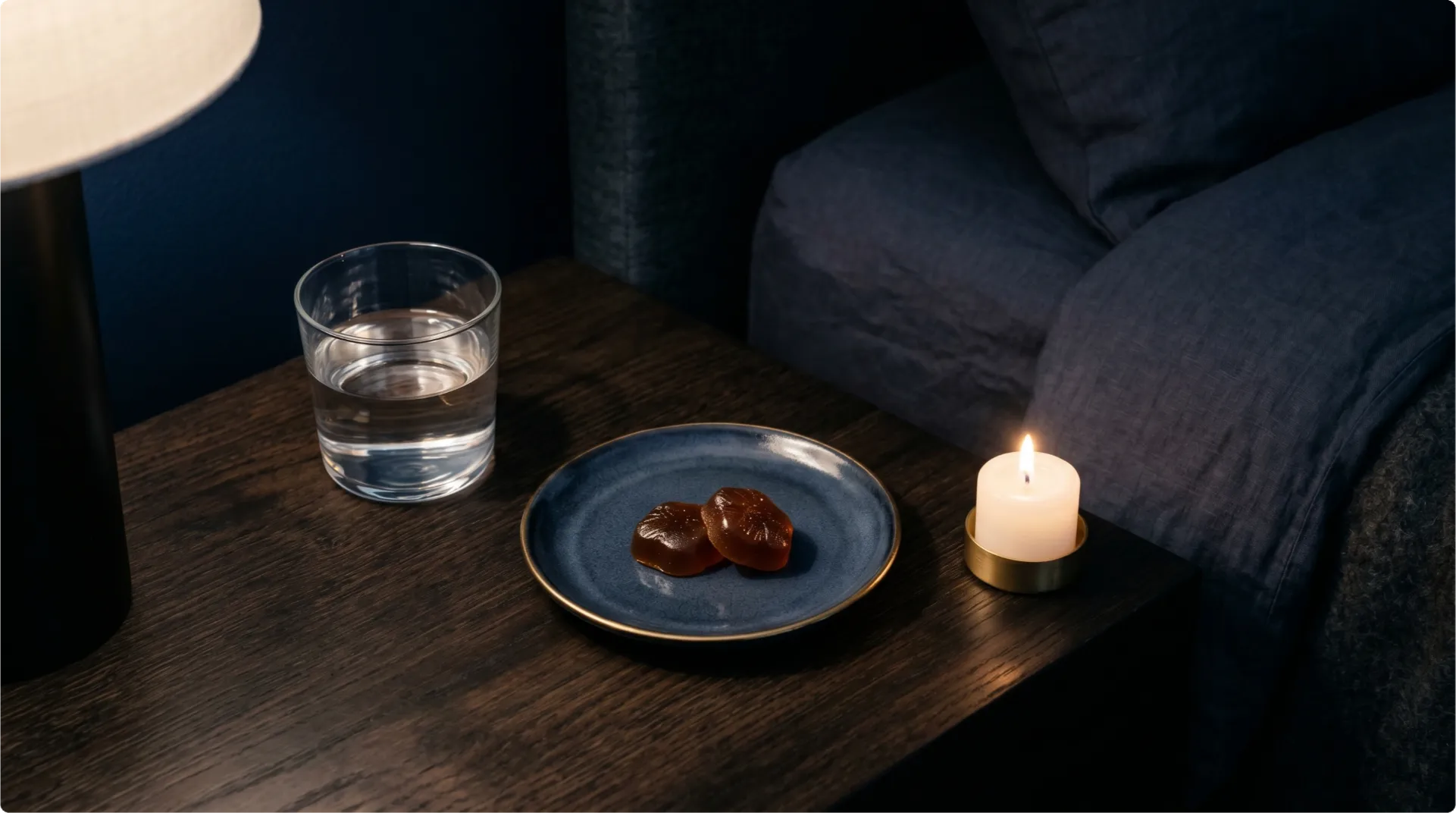
When duration matters more than speed, edibles are the better tool. Sleep is the clearest example. If you want something that carries you through the night without needing to re-dose, the 4 to 8 hour window of an edible is built for that. A 2025 meta-analysis published in Sleep Medicine Reviews, covering six randomized controlled trials and more than 1,000 participants, found that THC and CBN combination formulations significantly improved subjective sleep quality compared to CBD-only products (Sleep Medicine Reviews, 2025). Gummies formulated with both THC and CBN, available at licensed New York dispensaries, are specifically designed for this use case.
Edibles are also the right call for longer social events or situations where re-dosing would be inconvenient. You take one serving, you know roughly what to expect, and you're covered for several hours. There's no dropper to manage and no timing to track in the middle of an evening.
The fixed-dose format works in your favor once you know how your body responds to a given product. New users benefit from starting at 2.5 to 5mg and treating the first session as calibration. New York's 10mg per-serving ceiling provides a guardrail. The NORML summary of clinical trial data on THC and CBN formulations (2025) reinforces that low-to-moderate dosing produces the most consistent outcomes in first-time and returning users.
Is there a middle ground between tinctures and edibles?
The tincture vs. edible framing assumes a binary choice. There's a third option that most comparison articles skip entirely.
Fast-acting sublingual edibles, typically sold as mints or lozenges, combine the convenience of an edible with onset times that are closer to a tincture. They dissolve under the tongue or absorb through the cheek, largely bypassing the digestive pathway. Onset typically falls between 15 and 30 minutes, compared to the 45 to 90 minutes of a standard gummy (Explore Sherpa, 2024). For someone who wants the familiarity of a solid format but needs faster, more predictable timing, this category is worth knowing about. Licensed New York dispensaries carry sublingual formats alongside traditional tinctures and edibles.
The format you choose should follow your intent
Most people overthink the tincture vs. edible decision and underthink the intent question. The format isn't the starting point. What you want to feel, when you want to feel it, and how long you need it to last – those are the questions that point you to the right shelf.
Tinctures give you speed and control. Edibles give you duration and depth. Sublingual edibles sit between the two. None of them are universally better. Each one is the right answer for a specific situation.
Please note
This content is for educational purposes only and does not constitute medical advice. Cannabis affects individuals differently. Must be 21+ to purchase in New York State.
FAQs
Edibles are generally more intense and longer-lasting. The liver converts THC into 11-hydroxy-THC during digestion, a compound that is more potent than THC absorbed sublingually. Tinctures deliver a lighter, more predictable effect. Stronger is not always better. The right choice depends on what you're trying to accomplish and how much experience you have with each format.
Tinctures taken under the tongue typically take effect in 15 to 45 minutes. Edibles range from 45 to 90 minutes, depending on your metabolism, what you've eaten, and your tolerance level. Individual variation is real. Those numbers are ranges, not guarantees.
This is not recommended, especially for people without significant experience with both formats. The two pathways arrive at different times and at different intensities. Managing the combined effect is difficult to predict. Starting with one format at a time gives you a much cleaner read on how your body is responding.
For both formats, 2.5 to 5mg THC is a sensible starting point for new or returning users. New York's 10mg per-serving edible limit is a regulatory ceiling, not a recommended dose. Tinctures allow you to adjust in real time by changing how many drops you take. Edibles are fixed per serving, so choosing a lower-dose product matters more at the start.
Both can work. Edibles with THC and CBN are the more common sleep choice because of their longer duration. Research published in Sleep Medicine Reviews in 2025 found that THC plus CBN formulations outperformed CBD-only products across six clinical trials in improving sleep quality (Sleep Medicine Reviews, 2025). Tinctures suit users who want to fall asleep without the effects carrying into the following morning. The right answer depends on your sleep pattern, your experience level, and what's worked for you before.
Visit JD's Jungle
The best next step is a conversation. JD's Jungle budtenders can match you to the right format for what you're actually trying to do, not just what's available. Visit us in New York to explore our curated selection of tinctures, edibles, and sublingual formats, all sourced from licensed producers and backed by full lab documentation.
Find a locationReferences
- Explore Sherpa. (2024). What are sublingual edibles? A guide to fast-acting cannabis products. https://www.exploresherpa.com/blogs/our-blog/what-are-sublingual-edibles
- New York State Office of Cannabis Management. (2025). OCM annual report 2025. https://cannabis.ny.gov/system/files/documents/2025/12/ocm-annual-report_final-2025.pdf
- Sleep Medicine Reviews. (2025). Meta-analysis: THC and CBN formulations and sleep quality. https://www.sciencedirect.com/science/article/abs/pii/S1087079225001091
- NORML. (2025). Clinical trials: THC and CBN, but not CBD, associated with improved sleep quality. https://norml.org/news/2025/10/09/clinical-trials-cannabis-formulations-dominant-in-thc-and-cbn-but-not-cbd-associated-with-improved-sleep-quality