You have two options in front of you. One takes effect in about five minutes. The other might take ninety. Both contain cannabis. Both are legal in New York. But they will produce completely different experiences, and choosing between them based on strength alone is one of the most common mistakes people make. The question is not which format is more powerful. It is which one matches what you are actually trying to do.
TL;DR
Edibles hit differently than smoking, and the difference matters. It comes down to onset, duration, and how much control you want — not THC percentage.
The difference between edibles and smoking comes down to how your body processes THC from each format. When you smoke, THC enters the bloodstream through the lungs in minutes and produces effects that last one to three hours. When you consume an edible, THC travels through the digestive system and is converted by the liver into a different compound called 11-hydroxy-THC. This process takes 30 to 90 minutes, sometimes longer, but the effects that follow are typically stronger and last four to twelve hours.
What is the difference between edibles and smoking cannabis?
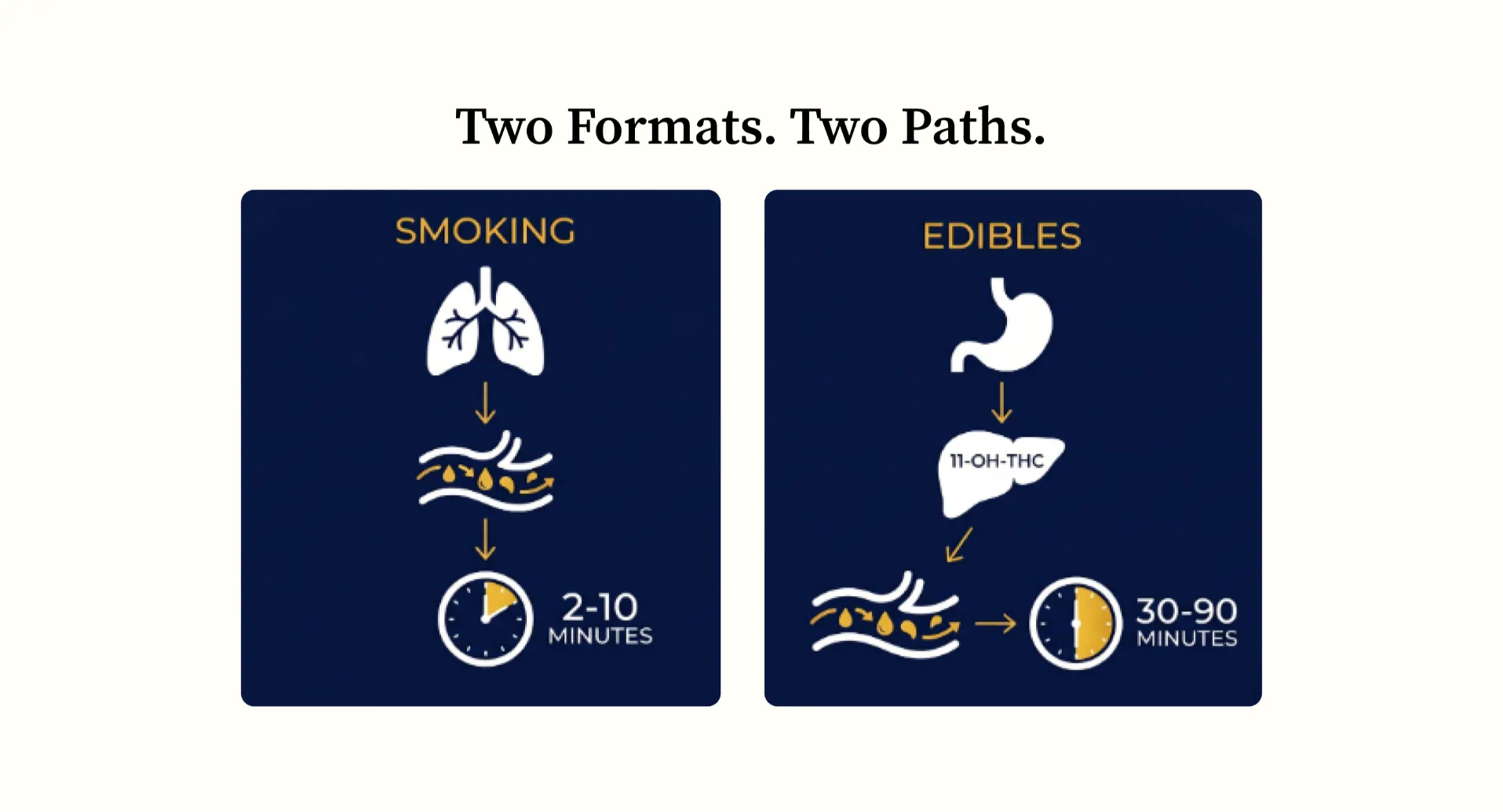
The core difference between edibles and smoking is the route THC takes to reach your brain.
When you smoke cannabis, THC passes through your lungs and into your bloodstream almost immediately. The bioavailability of smoked THC, the percentage that actually reaches your system, is approximately 31%, though this varies depending on how deeply you inhale (Cannovia, 2024). Effects arrive fast, peak quickly, and fade within one to three hours.
Edibles follow a slower route. After you eat a gummy or a chocolate, it moves through your stomach and into the liver. There, your liver converts delta-9 THC into 11-hydroxy-THC, a metabolite that crosses the blood-brain barrier more efficiently than the original compound. The result is a stronger, longer-lasting effect, but one that can take anywhere from 30 minutes to three hours to arrive. Edibles deliver only 10 to 20% of THC to your system, but what does reach your brain is more potent per milligram than what you would absorb from smoking the same amount (Cannovia, 2024).
This is why the same person can smoke regularly and still be caught off guard by a 10 mg edible. The compounds are not the same.
Edibles vs. smoking pros and cons: what each format actually gives you
What smoking offers
Smoking delivers speed and control. Effects typically arrive within two to ten minutes, which means you can calibrate your experience as you go. If you have smoked enough, you know it quickly and can stop. If you want a little more, the window is short and predictable.
The duration tends to stay within one to three hours, which suits a defined window of time. Post-work. Before a film. A social setting where you want to be present but not committed to a four-hour experience. The ritual of it matters to some people too. There is an intentionality to preparing and smoking cannabis that edibles do not replicate.
The main consideration is respiratory. Chronic daily smoking can irritate the lungs over time (City Distributions, 2024). For occasional use this is less of a concern, but it is worth knowing if you are planning to use cannabis regularly.
What edibles offer
Edibles offer duration and discretion. Once the effect arrives, it tends to stay. The average experience runs four to eight hours, with some high-dose sessions extending beyond that depending on your metabolism and what you have eaten beforehand (Prairie Cannabis, 2025).
The stronger effect comes from the 11-hydroxy-THC conversion described above. Many people describe edibles as producing a more body-centred experience, heavier, more settled, harder to shake if you have taken too much. This is useful for sleep, extended relaxation, or situations where you want the effect to carry through without needing to re-dose.
Discretion is the other advantage. No smoke, no odour, nothing visible. In a city environment where you may be in a building with restrictions or in a shared space, this matters. An edible fits in a pocket.
The main risk is the delay. The most common mistake is taking a dose, feeling nothing after 45 minutes, and taking more. Two hours later both doses arrive at once. Start at 2.5 to 5 mg of THC if you are new to edibles or returning after a break. Wait the full two hours before deciding the dose has not worked (The Holistic Center, 2026).
| Factor | Smoking | Edibles |
|---|---|---|
| Onset time | 2–10 minutes | 30 minutes – 3 hours |
| Peak effects | 10–30 minutes | 2–3 hours |
| Duration | 1–3 hours | 4–12 hours |
| THC bioavailability | ~31% | 10–20% |
| Active compound | Delta-9 THC | 11-hydroxy-THC (more potent) |
| Dose control | Easier – effects are immediate | Harder - delayed feedback |
| Discretion | Low (odour, visible smoke) | High (no odour, portable) |
| Overconsumption risk | Lower | Higher if redosing too soon |
| Best for | Fast relief, social use, short sessions | Sleep, sustained effects, discreet settings |
How long do edibles last compared to smoking?
This is where the two formats separate most clearly.
Smoked cannabis typically produces noticeable effects for one to three hours. The peak arrives fast, fades steadily, and most people feel clear within three hours of their last inhalation. Residual effects, a mild relaxed feeling, can linger, but they are not intrusive.
Edibles work on a different clock. The effects can last four to twelve hours depending on the dose, the individual, and whether they consumed food beforehand (Prairie Cannabis, 2025). A 10 mg edible taken at 8 pm can still be producing effects at 2 am. For sleep this can be exactly what you want. For a casual Tuesday evening where you plan to be functional the next morning, it requires planning.
The reason for the extended duration is the half-life of 11-hydroxy-THC. This compound persists in the body longer than delta-9 THC, which is why the experience feels sustained rather than peaking and dropping. It also means that if you have taken more than you intended, the feeling will not pass quickly. This is not dangerous, but it is uncomfortable, and it is avoidable with the right starting dose.
When should you choose edibles, and when does smoking make more sense?

When edibles are the right choice
Edibles work well when the goal is a longer, more contained experience. If you are winding down for the evening, using cannabis to support sleep, or heading into a setting where smoking is not practical, edibles give you duration and discretion.
In New York specifically, this is a practical consideration. Many apartment buildings have restrictions on smoking indoors. Edibles remove that variable entirely. There is no odour, no smoke, and nothing that draws attention.
They are also the better option for new users or anyone who tends toward anxiety with cannabis. A low-dose edible at 2.5 mg gives you a gentle, controlled starting point. The effect builds slowly enough that it rarely catches you off guard if dosed correctly.
When smoking is the right choice
Smoking fits the moments where speed and precision matter. If you want to feel something within minutes and have the ability to stop when you have had enough, smoking gives you that control. It is predictable in a way that edibles are not.
It is also the better social format for many people. The shared ritual, the defined window, the ability to step away and feel clear within a few hours — these are real advantages in the right setting.
Under New York's Marijuana Regulation and Taxation Act, adults 21 and older can legally smoke cannabis in most places where tobacco smoking is permitted, including some sidewalks and outdoor spaces. Consumption is prohibited in vehicles, workplaces, restaurants, and on federal property (NY Office of Cannabis Management, 2025). Know where you are before you light up.
What New Yorkers should know about using edibles and smoking cannabis legally
New York's adult-use cannabis market operates under the Marijuana Regulation and Taxation Act (MRTA). Adults 21 and older can legally purchase, possess, and consume cannabis products from licensed dispensaries (Stoops NYC, 2025).
For smoking: legal in most places where tobacco is permitted. Prohibited in vehicles, workplaces, schools, restaurants, bars, and on any federal property including parks. Building-specific rules may impose additional restrictions, so check posted notices.
For edibles: the same consumption location rules apply. Edibles can be consumed in private residences and most places where tobacco use is allowed. They cannot be consumed in vehicles or any of the locations listed above. Adults may possess up to 3 ounces of cannabis or 24 grams of concentrate, a category that includes edibles and oils, at any one time (Stoops NYC, 2025).
All purchases must come from a licensed dispensary. Licensed products are tested, labelled accurately, and regulated for potency. This matters when choosing edibles in particular, because the dose on the label is the dose in the product. That level of reliability is not guaranteed anywhere else.
Conclusion
The edibles vs. smoking comparison is not really about which one is stronger. It is about timing, duration, and how much control you want over the experience. Smoking gives you speed and precision. Edibles give you duration and discretion. Neither is wrong. Both require the right dose and the right setting.
The format that works best is the one chosen with intention. That is what separates a good cannabis experience from a bad one. Not the THC percentage. Not the format itself. The fit between what you chose and what you actually needed that evening.
Please note
This content is for educational purposes only and does not constitute medical advice. Cannabis affects individuals differently. Must be 21+ to purchase in New York State.
FAQs
They tend to feel stronger, yes. The reason is what happens in the liver. When you eat an edible, delta-9 THC is converted into 11-hydroxy-THC, a compound that binds to cannabinoid receptors more efficiently and crosses the blood-brain barrier more easily. The experience is often described as more intense and more body-centred than smoked cannabis, even at a similar milligram dose (Everest Dispensary, 2025).
The route of absorption is different. Smoked cannabis bypasses digestion entirely and enters the bloodstream through the lungs in minutes. An edible has to travel through the stomach and liver before any THC reaches your brain. That process takes 30 to 90 minutes on average, and longer if you have eaten a full meal. The liver conversion to 11-hydroxy-THC adds time, and individual digestion speeds vary considerably (City Distributions, 2024).
Start at 2.5 to 5 mg of THC. Your smoking tolerance does not translate to edibles because the active compound is different. Wait the full two hours before considering more. The most common error people make is deciding the edible has not worked and taking a second dose, only to have both arrive together. Slow is the right pace here (The Holistic Center, 2026).
Yes, in most locations where tobacco smoking is permitted. This typically includes some sidewalks and outdoor public spaces. You cannot smoke in vehicles, workplaces, schools, restaurants, bars, or on federal property. Local building rules may be stricter. Always check posted signage before consuming in an unfamiliar space (NY Office of Cannabis Management, 2025).
Edibles are generally more effective for sleep. The longer duration means the effect carries through several hours rather than fading before deeper sleep stages arrive. A low-dose edible of 5 mg or under, taken 60 to 90 minutes before bed, gives most people a more consistent result than smoking, which typically wears off within two to three hours (Napa Cannabis Collective, 2025).
Visit JD's Jungle
Not sure which format fits what you have in mind? Our team works through that with every customer. Visit JD's Jungle in New York, tell us what you are looking to feel and when, and we will help you find the right product.
Find a locationReferences
- Cannovia. (2024). THC joints vs edibles: Onset, duration and which hits harder. https://cannovia.com/blogs/discover/thc-joints-vs-edibles
- City Distributions. (2024). Smoking vs. eating THC: A comprehensive comparison. https://citydistributions.com/blogs/news/smoking-vs-eating-thc-a-comprehensive-comparison
- Prairie Cannabis. (2025). Eating vs. smoking cannabis: Key differences. https://prairiecannabis.com/smoking-vs-edibles-effects-dosage-guide/
- NY Office of Cannabis Management. (2025). Law enforcement. https://cannabis.ny.gov/law-enforcement
- Stoops NYC. (2025). New York's 2025 cannabis laws explained. https://stoopsnyc.com/blog/new-york-marijuana-laws/